Indiana Dunes National Park: an artist residency

In September 2025 I was an artist in residence at Indiana Dunes National Park. As part of my residency, I created a piece of stitched paper artwork for the park. "Long Lake" is now part of their collection.
Making artwork at Indiana Dunes National Park
DAY 1: I arrived at Indiana Dunes National Park late on a Friday afternoon, and after getting settled into the house where I would live for the next two weeks, I went in search of the lake. Evening was deepening, and people were making their way toward the beach, carrying chairs and blankets in hopes of seeing the sun set over the lake. I was carrying my camera and a watercolor sketching kit, hoping to get in a sketch or two before losing the light.
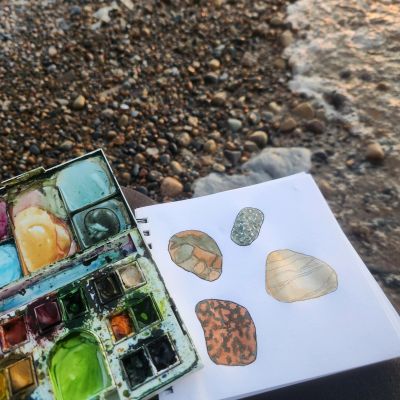
I was immediately distracted by the smooth stones that collected along the water’s edge. Speckled, striped, pocked with holes - but all worn rounded and smooth by the action of the waves. I was so taken with their interesting colors and textures that I pulled out my watercolors and made a few sketches.
I waited with everyone else for the sunset, then went back to the house to settle in.
DAY 2: I grew up not far from here, and spent summer days at the Indiana Dunes beaches, but I left for college at 18, lived in Delaware and Minnesota before moving to the woods of Southern Indiana, and rarely made it back up to the Dunes. When I got the residency, I pictured wandering the sandy dunes and beaches - and there’s plenty of that here - but I was unprepared for the vast diversity that the National Park has to offer (it’s the fifth most biodiverse national park). There are, incredibly, ten different habitats in the park: lake, beach, dunes, interdunal ponds, marsh, oak savanna, prairie, river, fen, and bog. I was hoping to see them all.
I headed to the Little Calumet River Trail and hiked the stretch through the Mnoke Prairie to where the trail crosses the river. The prairie was alive with late summer flowers, including goldenrod in abundance, and native grasses whose seed heads waved in the light wind.
The trail made its way into the woods, but a woods unlike any I had seen before. This is a liminal space, an ecotone where prairie meets forest, and the understory is covered with a combination of prairie and woodland plants - goldenrod growing right next to white baneberry and asters. The park is famous for these ecological transition zones.
I followed the trail until it crossed the Little Calumet River, where I saw some cool plants - wild cucumber (Echinocystis lobata) being the most noteworthy - before retracing my steps back to my car.
I made some watercolor sketches of the landscape, hoping to capture the shapes and colors so I could eventually translate them into stitched paper collage.

Sketches in Mnoke Prairie
DAY 3: When I told a park employee how much I liked the woods that abutted Mnoke Prairie, they suggested I try the Miller Woods trail, which is a rare oak Savanna habitat. Miller Woods looks like a prairie dotted with black oaks, under which grow shrubs like sumac and chokecherry and prairie flowers like blazingstar. This kind of habitat is endangered, with an estimated 0.02% of high-quality oak savanna remaining in the Midwest.
The trail is under a mile long, but it took me four hours to walk it. There were so many plants that were new to me, and I stopped to photograph everything and sketch a few times.
I ended the day sketching on Lake View Beach, where people stopped to chat and see what I was up to.
Sketching Miller Woods
DAY 4: I was given a driving tour of the entire park, which stretches about 15 miles along the shore of Lake Michigan, plus has some remote sites, including a prairie and a bog. The park is quite unusual - as you drive along U.S. 12 from one natural habitat to another, you pass steel mills and other industrial sites. Nestled among the natural wonders of the park are the neighborhoods, towns, and industries that make up the surrounding region. On every beach in the park, you can see power plants and industrial columns (and often even the Chicago skyline) in the distance. Nature and industry are embedded so tightly together the National Park Service calls this region “the land of sand and steel.”
Beach with industry seen in the background
DAY 5: I dedicated all of day 5 to the West Beach area, which has two one-mile trails: a dune succession trail and a trail through an area being restored as an oak savanna.
I climbed more than 150 stairs to reach the top of the first dune, sat on a bench on an overlook, and made a sketch looking out over Lake Michigan.
The trail went down from there, and in the direction I was headed, the landscape went backwards through dune succession: oak forest gave way to jack pine barrens and interdunal wetlands, which became sand dunes rooted by marram grass and cottonwood trees, which let out onto West Beach and the lake.
After a quick lunch, I headed out on the other trail, which went into fields completely covered with rough blazingstar, showy goldenrod, and tall boneset.
There were more monarch butterflies than I have seen since I was a child, where I grew up in the 70s and 80s next to an open, unplowed field full of milkweed and goldenrod. There were hundreds of monarchs, and I spent quite a bit of time just watching them fly from flower to flower.
The trail skirted Long Lake, an interdunal wetland, where I sat on the viewing platform, watching sandhill cranes and egrets feed, and sketching.
I even saw Indiana’s only native cactus - the Eastern Prickly Pear - which grows in several places along this trail.
Monarchs on Tall Boneset
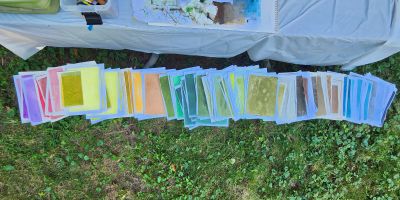
DAY 6: By now I had enough sketches to do a session of gel plate printing (plus, my body needed a break from hiking). I use junk mail and other leftover or discarded papers, a gel plate, and acrylic paints to create collage papers in the colors and textures I need for my stitched paper artwork.
I worked outside on a picnic table, serenaded by insects and birds, until evening approached and the mosquitoes forced me inside.
DAY 7: Though the road to Portage Beach is shared with a steel mill, and at the stop sign trucks loaded with steel coils alternate with cars going to the beach, once on the beach, you’d never know you’re a stone’s throw away from industrial manufacturing. I had a short sketching session in the sunshine.
After lunch I met some local friends at the Great Marsh, and walked the trail with them, trying to identify native plants and looking for cool bugs. There were a pair of swans out on the water, and frogs calling from the wetlands on both sides of the trail.
In the week I’ve been at Indiana Dunes National Park, I’ve documented more than 100 species of native plants. I think I’ll start a series of watercolor sketches of them. Sketching something, even making a quick or “bad” sketch of it, requires an entirely different kind of looking that photographing it. I count the petals when I’m sketching. I notice whether leaves are opposite each other or alternating down the stem, and whether those leaves have serrated or smooth edges. I get to know the plant more intimately.
Sketches of native plants
Day 8: Cowles Bog is not scientifically a bog, but a fen. Bogs are wetlands nourished only by rain and snowfall, so they have stagnant, highly acidic water. Fens are fed by fresh groundwater, and Cowles Bog is a fen surrounded by marsh and trees, forming a “swamp complex” that supports lots of interesting life.
I was only able to do a part of the Cowles Bog trail that traveled through a wooded area. I saw a lot of cool plants, including cinnamon ferns as tall as my waist, winterberry bushes covered with red berries, white rattlesnake root flowers, and yellow birches hosting birch polypore mushrooms and coral tooth fungus.
I only stopped to sketch once, when I found a flush of chicken-of-the-wood mushrooms growing out of a root right in the middle of the trail.
I felt like I had gathered enough inspiration photos and sketches to begin some collages. Among other little experiments, I chose to work on a view of Lake View Beach that I had both photographed and sketched on day 3. Choosing from the papers that I gel plate printed on day 6, I tore sections, arranged them on a piece of upcycled cotton backing, and pasted them down with methyl cellulose, a reversible adhesive that keeps the papers in place until I can stitch into the collage. I left this to dry overnight.
Lake View Beach collage, before stitching
DAY 9: Before I made my first collage, I experimented with how I might reproduce the Cottonwood trees that are ubiquitous at Indiana Dunes. Although I’m using my sewing machine, it is a form of sketching, where I can work out details and experiment a bit. I use scrap bits of paper and some of my gel plate printed papers.
When I was satisfied with my experiments, I dove into the first collage. Each section requires decisions, including thread color; sewing pattern, direction and density; and whether or not to outline elements to emphasize them. With this work, there’s really no way out but through, so I started at the top, stitching into the sky, and worked my way to the bottom. At the end, I added the cottonwood tree at the top left and the large rocks along the bottom of the image.
Lake View Beach collage, after stitching
DAY 10: The Dune Ridge Trail begins near Kemil Beach, and winds through forest, climbing up to give a sweeping of the Great Marsh. I sat on the bench at the very top of the dune and sketched it, and several people stopped to see what I was painting.
I spent some time at Kemil Beach as well. Each of the beaches here is different, and this one offers a long stretch of sand bordered by Marram Grass. I’m here after Labor Day, so the beaches are not crowded. This place continues to feel much more remote than it really is.
In the afternoon and evening, I stitched my second collage, this one of Long Lake. After stitching the background, I wanted more interest in the foreground, so I replaced the cattails with a willow tree I had seen on the edge of Long Lake, and I moved to the front of the piece the sandhill cranes I had watched feeding in the wetland.

View of the Great Marsh
DAY 11: You can only enter Pinhook Bog on a ranger-led tour, and it was closed for the season, but a special tour was arranged for the other artist-in-residence, Alan Baseden, and me.
Pinhook Bog is a wild and magical place. The bog formed when a chunk of a glacier broke off and created a kettle lake. From the National Park signage at the bog:
“Clay-rich sediment beneath Pinhook Bog left by the glacier acts as an impenetrable bowl that groundwater cannot flow through. With no major inlets or outlets, the only source of water into Pinhook’s basin is rainwater. These conditions make the water oxygen-poor, which slows the decay of dead plants. As dead plant matter builds up, the water acidifies. Stagnant and acidic water with dead logs and vegetation provides ideal habitat for sphagnum moss to grow and spread. Over a few thousand years, the sphagnum eventually covered the surface of the old glacial lake.”
Visiting Pinhook Bog is like stepping into a hidden world suspended between land and water. The boardwalk trail floats atop a spongy mat of sphagnum moss through a delicate ecosystem shaped over thousands of years. Plants and even full-grow trees grow in the bog, rooted entirely in the thick sphagnum layer.
There are lots of sedges, grasses and rushes, as well as ferns and orchids and other plants rooted in the sphagnum moss. But the highlight by far is the carnivorous plants that thrive in the bog environment.
We saw Purple Pitcher Plant and Spoonleaf Sundew, both of which supplement their nutrient-poor habitat by eating insects.
I feel incredibly lucky to have visited Pinhook Bog - it’s a rare and fragile ecosystem that few people get to experience. Walking along the floating boardwalk, surrounded by carnivorous plants and mossy wetlands, felt like entering a secret world preserved through time. Being there reminded me how extraordinary nature can be, and how many strange and wonderful secrets it contains.
Sketching pitcher plants in Pinhook Bog
DAY 12: I spent some time back on Lake View Beach. I keep going back there because it is both lovely and accessible (there is a parking area immediately adjacent to the beach). These two weeks have involved a lot more walking than my chronically ill body can tolerate, and I need rest days to let my legs recuperate.
I sketched some more stones. Since you can’t remove anything from a National Park, this is the best way to take them home with me.
Then I spent the rest of the afternoon and evening sewing a third collage, this one of the West Beach trail I walked on day 5, the one with all the rough blazingstar in bloom among the oak trees.
West Beach trail collage
DAY 13: Lake Michigan was a different lake today. The wind was blowing strongly inland, and the waves were crashing on the shore, tossing rocks as big as softballs onto the beach.
I took my sketching bag to Lake View Beach, where I knew there were picnic tables I could sit at and sketch, but the energy of the lake drew me down onto the beach. At first, there were a few other people walking the beach, and they seemed equally under the spell of the wild water. Like a magpie, I was attracted by the beautiful wet stones at the waterline. It’s illegal to remove stones from a National Park, so I photographed the ones I found most intriguing, waiting until the waves retreated to dodge out and pick them up, retreating from the waves as they rolled back in, until my shoes and socks were soaked.
When I looked up again from my stone searching, I realized I was the only one on the beach as far as I could see.
There’s something electrifying about standing on a wild, windy beach—the gusts whipping your hair into a frenzy and the waves’ unpredictable crashing. The air feels charged, alive with possibility, and the roar of the wind drowns out the noise of everyday life. I felt small and powerful all at once, swept up in the raw beauty of the elements, reminded that the world is vast, wild, and wonderfully unpredictable.
Empty, windy beach
DAY 14: I chose the Long Lake collage as my final piece, which I framed donated to the Indiana Dunes National Park to be in their collection.
Though I finished this piece, I still have plenty of photos, sketches, impressions, and ideas that I will take home with me. I plan to create a series of works that will attempt to capture the astounding diversity and beauty of this place. I'm deeply grateful for this opportunity —it’s given me the space and time to fully immerse myself in creative exploration in a new landscape. The residency has not only nurtured my practice but reminded me of the importance of letting inspiration unfold organically. I leave with a renewed sense of purpose, a richer connection to my work, and heartfelt appreciation for everyone who made this experience possible.
Here you can see a small artist book I made of the habitats at Indiana Dunes National Park.
Long Lake
Long Lake

Sketch of Long Lake
Collage of Long Lake, before stitching
Collage of Long Lake, after stitching
Detail (Sandhill cranes)
Detail (tree)
Long Lake, framed