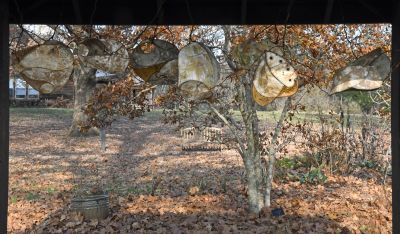
Health/Care Network: A residency at Bernheim Forest

This piece was made as part of my artist residency at Bernheim Forest & Arboretum.
Science has shown that spending time among trees bolsters our immune system, suggesting that trees can improve our health.
Each of the seven cellular structures in Health/Care Network were based on one individual tree in the arboretum. Paper was eco-printed with leaves from the tree and mounted to an armature made from foraged invasive vines. Hand embroidery was inspired by things I observed about each tree: leaves, branches, bark, lichen, and moss.




The artwork installed
Seven Conversations with Seven Trees
An artist residency
When I arrived at Bernheim Forest and Arboretum for my artist residency in September 2024, I expected to find inspiration in the beauty of the landscape. Bernheim, located just south of Louisville, is the largest privately owned forest dedicated to education and conservation in the United States. Spanning over 16,000 acres (600 acres of arboretum and the rest wild forest), it was established in 1929 by Isaac W. Bernheim, a German immigrant and distiller who purchased degraded farmland with the intent of restoring it to native forest. Today it is owned and managed by the Bernheim Foundation, and includes protected natural areas, sustainably managed woodlands, an arboretum with curated plant collections, over 40 miles of trails, and lots of public art.
When I arrived for my seven-week stay, I knew I would be eco-printing on cotton rag paper with leaves from Bernheim’s trees, stitching into the paper, and mounting it onto foraged vine armatures. I expected my subject matter to continue the exploration of chronic illness that I had been pursuing for the previous few years. What I didn’t expect was how deeply personal my encounters with the trees would become, and how my attention would turn from the grief of chronic illness to the role trees play in making us healthier.
After I had familiarized myself with the grounds, I began to collect leaves for eco-printing. It was autumn and leaves were freely falling from most of the trees. Though no collecting of any kind is allowed at Bernheim, I was given special permission to collect fallen leaves for my project. I assumed I would be most interested in the wild native forest, but, while I enjoyed hiking the forested trails, I was drawn instead to the arboretum section, a living library of trees, spaced intentionally across the landscape, labeled with their names in both English and Latin. I was interested in featuring trees native to Kentucky in my project, and as I wandered the arboretum each day, I began to find favorite trees. Not favorite tree species, which I already had – sassafras and sycamore - but favorite individual trees.
At this point, I realized I would do something a bit different with this project. In the past, when eco-printing, I would walk into my own woods and gather handfuls of fallen leaves. These were a mixture of species, and I had no way of knowing which specific oak leaves fell from which specific oak trees once they were on the ground. Here, with the trees spaced across the landscape the way they were, and the grounds tended the way they were, leaves I gathered felt like gifts from specific trees I had come to recognize.
The artists in residence at Bernheim have the use of a lovely lakeside studio. I set up my sewing machine inside the studio, and I created a space on the studio patio where I could eco-print onto papers. There were several experiments I needed to conduct before I started the project – I was using cotton rag paper for the first time (in the past I had used leftover wood pulp paper from bookbinding). That meant I might need to experiment with mordants and make sure I could get good results with my method of steaming the paper and leaves.
For my first experiments, I chose a few trees that were right next to the studio – a Japanese zelkova tree and a whitebark magnolia. These were not native to Kentucky, so I knew they wouldn’t end up in my final project, but they were close by and would serve to verify my eco-printing process was set up properly. The final papers bore nice prints, with subtle variations in tone and texture. I could move on to my project!

The Lakeside studio
At the same time, I spent my evenings reading about forests and trees. I read Suzanne Simard’s Finding the Mother Tree, where she discusses the way trees are all connected to each other and perhaps even care for each other through the “wood-wide web” of mycelial networks. I read Forest Bathing by Dr. Qing Li, a Japanese physician and researcher, whose research shows that spending time among trees can reduce cortisol levels, lower blood pressure, calm anxiety, and even increase the number and activity of natural killer (NK) cells – part of our immune systems.
That discovery moved me. It suggested that being in the presence of trees doesn’t just make us feel better—it actually changes the chemistry of our bodies. We are healthier when we are connected to the forest. I began sketching simple cell forms in my notebook—circles within circles, linked and clustered—and I saw how these could become metaphors for the networks of exchange and care that link us with the more-than-human world.
My recent work had included mounting eco-printed papers onto armatures made from foraged invasive vines to make sculptures. I got permission to remove invasive honeysuckle from around the cabin where I was staying and formed them into cell-like structures based on the sketches I had made in my notebook.
I decided to make a series of these cellular structures, each one based on one particular tree I had come to know in the arboretum. I chose about 20 native trees, collected their fallen leaves, and eco-printed papers with them.

A page from my project journal
Parallel to this, I was having conversations with the staff at Bernheim, trying to decide where my final artwork might be installed. Indoor locations were limited, and it seemed appropriate to me that artwork made in collaboration with trees should be outside among trees, so I considered what it would mean to install my stitched paper artwork outdoors. Would it hold up to the weather? Cotton rag paper is pretty durable, and if I layered some buckram fabric between two layers of paper, the result was a pretty sturdy construction. I coated the papers with Renaissance Wax to render some water resistance. One interesting thing about Bernheim is that they don’t expect their art installations to last forever – they intend each piece to be installed from 2 to 5 years, and they’re very open to experimenting. I scouted the arboretum for semi-protected spots where the artwork would fit, and quickly settled on a small, empty pavilion. I especially liked the spot because it was near to the Sensory Garden and not far from the Meditation Trail. It felt like a good fit.

The pavilion where my artwork would be installed
Based on the size of the pavilion, I needed a total of seven cellular structures. I made seven cell-shaped armatures from foraged vines. And I chose seven trees, based on several criteria: they had to be native trees, I wanted them drawn from across the whole arboretum, and they needed to have made successful eco-prints on the cotton rag paper.
After I chose the trees, I began spending time with each one, sitting near them to journal, taking photographs of their trunks, their leaves, their nuts and seeds, and any moss, lichen and mushrooms growing on them.
Then, using only the eco-printed papers made from the first tree I chose – an American hornbeam – I cut the paper to fit the open sections of a vine armature. I layered each piece with buckram and another layer of cotton rag paper, then machine quilted the layers together, following the marks eco-printing made on the paper.
I hand embroidered into the paper, translating what I had observed about the hornbeam tree into stitches. The process was slow, meditative, embodied.
Hand embroidery based on moss I observed
Finally, I attached the stitched paper pieces into the vine framework using waxed linen thread and a modified bookbinding stitch. The gesture of stitching felt like suturing, like an act of repair. Each connection was deliberate, holding together fragments of vine and paper, structure and skin.
Mounting the quilt to the armature
While I was at Bernheim, I visited each of the other six trees multiple times, journaling under their canopies, photographing the bark and lichen and mosses, watching them change with the approach of autumn. When I returned home, I continued working on the project, drawing on all the material I had documented in my project journal. The seven cell structures emerged—seven conversations with seven trees in the arboretum.
1. American Hornbeam (Carpinus caroliniana)

American hornbeam tree

Lichen and moss on trunk
Paper eco-printed with hornbeam leaves
Project journal page
Embroidery based on lichen
Looping based on leaf cell structures
Completed structure
Completed structure
2. American Sycamore (Platanus occidentalis)
American sycamore tree
Underneath the tree

Paper eco-printed with sycamore leaves

Project journal page
Embroidery based on sycamore flowers
Embroidery based on sycamore seed ball
Completed structure
Completed structure
3. Pin Oak (Quercus palustris)

Pin Oak tree
Looking up
Paper eco-printed with pin oak leaves
Project journal page
Embroidery based on acorns
Embroidery based on birds nest fungi
Completed structure
Completed structure
4. Red Maple (Acer rubrum)

Red maple tree
Paper eco-printed with red maple leaves

Project journal page
Embroidery based on lichen/fungus on fallen branch
Embroidery based on maple flowers

Completed structure

Completed structure
5. Pawpaw (Asimina triloba)
Pawpaw tree
Paper eco-printed with pawpaw leaves
Project journal page
Embroidery based on pawpaw flower
Embroidery based on leaf cells
Completed structure
Completed structure
6. Shellbark Hickory (Carya laciniosa)
Shellbark hickory tree
Paper eco-printed with shellbark hickory leaves

Project journal page
Embroidery based on hickory nut
Embroidery based on lichen on fallen branch
Completed structure
Completed structure
7. Tuliptree (Liriodendron tulipifera)
Tuliptree
Paper eco-printed with tuliptree leaves
Project journal page
Embroidery based on mushrooms found on fallen branch
Embroidery based on gash made by lightning strike
Completed structure

Completed structure
Health/Care Network
This November 2025, I finally brought all seven structures together for installation, suspending them and connecting them to each other with “vines” made from covered and twisted metal wire.
Together, these seven forms—sycamore, pawpaw, red maple, shellbark hickory, tuliptree, pin oak, and hornbeam—hang in the pavilion like a suspended forest. Each one distinct, yet subtly linked to the others by vine-like cords, echoing the underground networks through which trees communicate and share sustenance. They move together in the wind.
Installed together, the work became Health/Care Network—a meditation on mutuality and resilience, both a portrait series and a map of interdependence. It asks what happens when we acknowledge our kinship with trees—not metaphorically, but biologically and spiritually. The cells of our bodies and the cells of trees both respire, exchange, and communicate. We are not separate from nature; we are an extension of it. When we care for trees, we care for ourselves. When we restore damaged ecosystems, we participate in our own healing.
Working on Health/Care Network taught me that every act of making is also an act of attention. To create something with care is to participate in a cycle of reciprocity that mirrors what happens in the forest. The trees gave their leaves, the vines their structure, the process its quiet lessons. In return, I offered my time, my attention, my willingness to learn.
When the installation was complete, I stood near the pavilion and watched the suspended forms move gently in the breeze. From this spot, I could actually see two of the seven trees – the shellbark hickory and the red maple - that had collaborated in the artwork.
In that moment, I felt the truth of Dr. Li’s research—not just as data, but as experience. Being among the trees, being in conversation with their materials, had changed me. I had entered into a network of health and care that extended beyond the boundaries of my own body. I had turned a corner, from making artwork about the grief and loss of illness, to the hope of finding healing and a new way of being in relationship to the woods.